
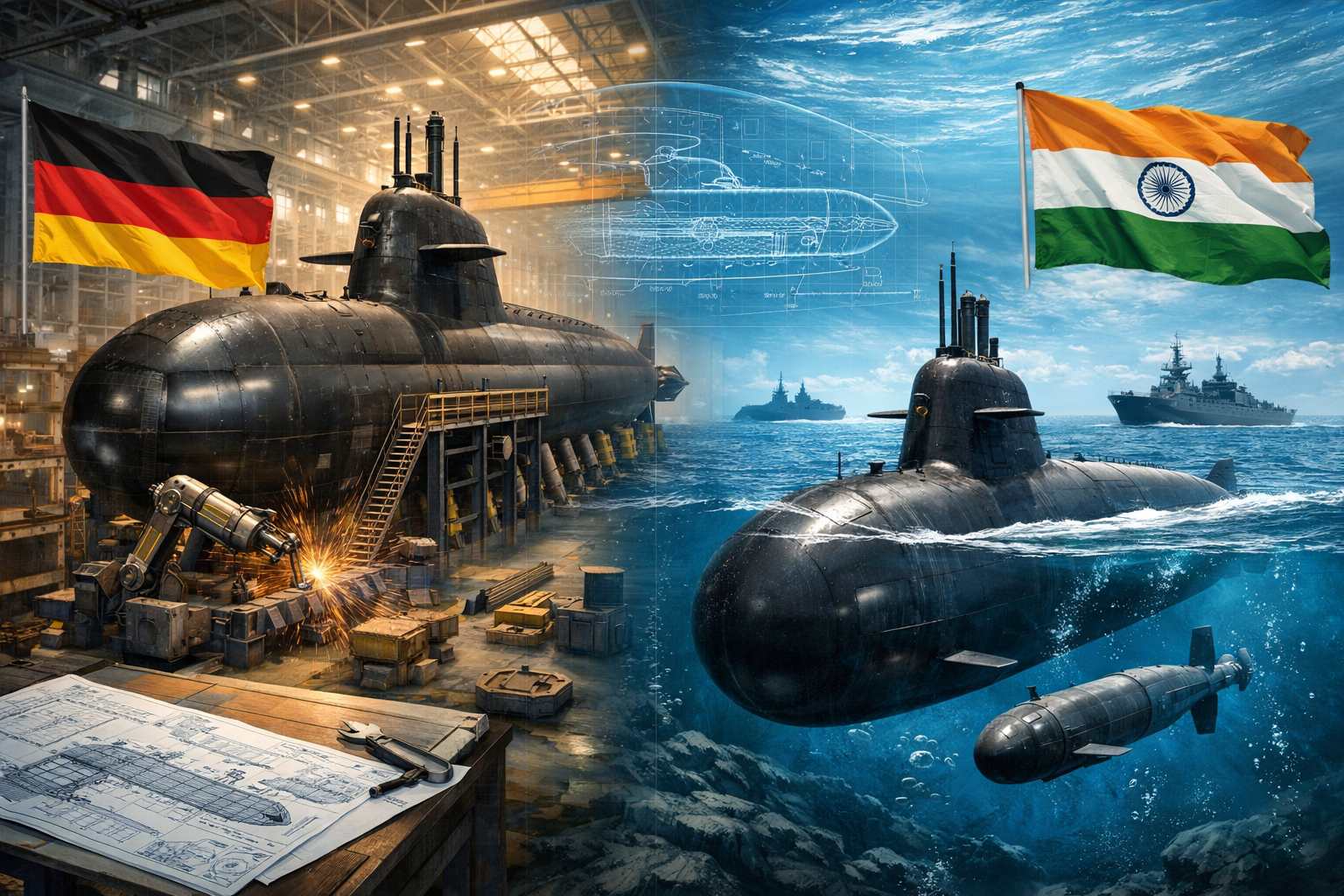
Germany and India are close to finalising a submarine manufacturing agreement that would significantly expand defence cooperation between the two countries and reshape India’s naval procurement strategy.
The deal, valued at at least $8 billion, as reported by Bloomberg, is set to become India’s largest-ever defence agreement and would introduce full technology transfer for submarine production, according to officials familiar with the discussions.
The negotiations have gathered pace ahead of German Chancellor Friedrich Merz’s visit to India next week.
If concluded, the agreement would allow submarines to be built domestically in partnership with a German manufacturer, marking a shift away from India’s long-standing reliance on imported naval platforms.
Manufacturing and technology focus
Under the proposed arrangement, Germany’s Thyssenkrupp Marine Systems would collaborate with India’s state-owned Mazagon Dock Shipbuilders to manufacture submarines in India.
Officials say, Bloomberg notes, the inclusion of technology transfer is central to the talks, as it would give Indian shipyards access to advanced design and production capabilities.
Technology sharing has often been a sticking point in previous defence purchases.
The current negotiations suggest a higher level of industrial trust, particularly given the complexity of submarine construction and the strategic sensitivity surrounding such platforms.
Impact on India’s naval plans
India’s navy currently operates roughly a dozen ageing Russian submarines alongside six newer French-built vessels.
According to Bloomberg, experts say the German deal would lead India to abandon plans to buy three additional French submarines, redirecting future fleet expansion toward the German-Indian manufacturing programme.
The submarines under discussion would be equipped with air-independent propulsion systems.
This technology allows vessels to remain submerged for longer periods than traditional diesel-electric submarines, improving endurance and operational reach in the Indian Ocean.
Strategic and diplomatic context
The proposed submarines would enhance India’s capacity to patrol vast maritime areas at a time when China is expanding its naval presence across the Indian Ocean region.
While the agreement is framed as an industrial partnership, it carries clear strategic weight for New Delhi’s maritime security planning.
For Germany, the willingness to share advanced submarine technology reflects a broader evolution in its defence posture.
Since Russia’s invasion of Ukraine, Berlin has accelerated defence production and sought to strengthen ties with partners beyond Europe, including India.
Broader cooperation agenda
The submarine talks form part of a wider diplomatic push during Merz’s first visit to India as chancellor.
He is scheduled to meet Prime Minister Narendra Modi in Gujarat before travelling to Bengaluru to engage with German companies operating in India.
Bloomberg states that officials say the two sides are also likely to explore closer cooperation in the pharmaceuticals sector.
Merz plans to use the visit to advance negotiations between the European Union and India on a long-pending free trade agreement.
This trip will be his first overseas visit, accompanied by a large delegation of German chief executives, underlining the economic dimension of the relationship.
A separate business-focused visit to China is also being planned, though dates have not yet been confirmed.
India’s defence manufacturing drive
India has spent years pushing foreign defence suppliers to manufacture locally and share expertise.
In 2020, the Modi government restricted imports of several major defence platforms to encourage domestic production.
Despite these efforts, Bloomberg notes, India remains the world’s second-largest importer of military hardware, with Russia still its main supplier, according to the Stockholm International Peace Research Institute.
Officials say the German submarine agreement would support India’s goal of reducing dependence on Russian equipment while strengthening indigenous defence manufacturing capabilities.
The post Germany, India near $8B submarine deal with full technology transfer appeared first on Invezz
