
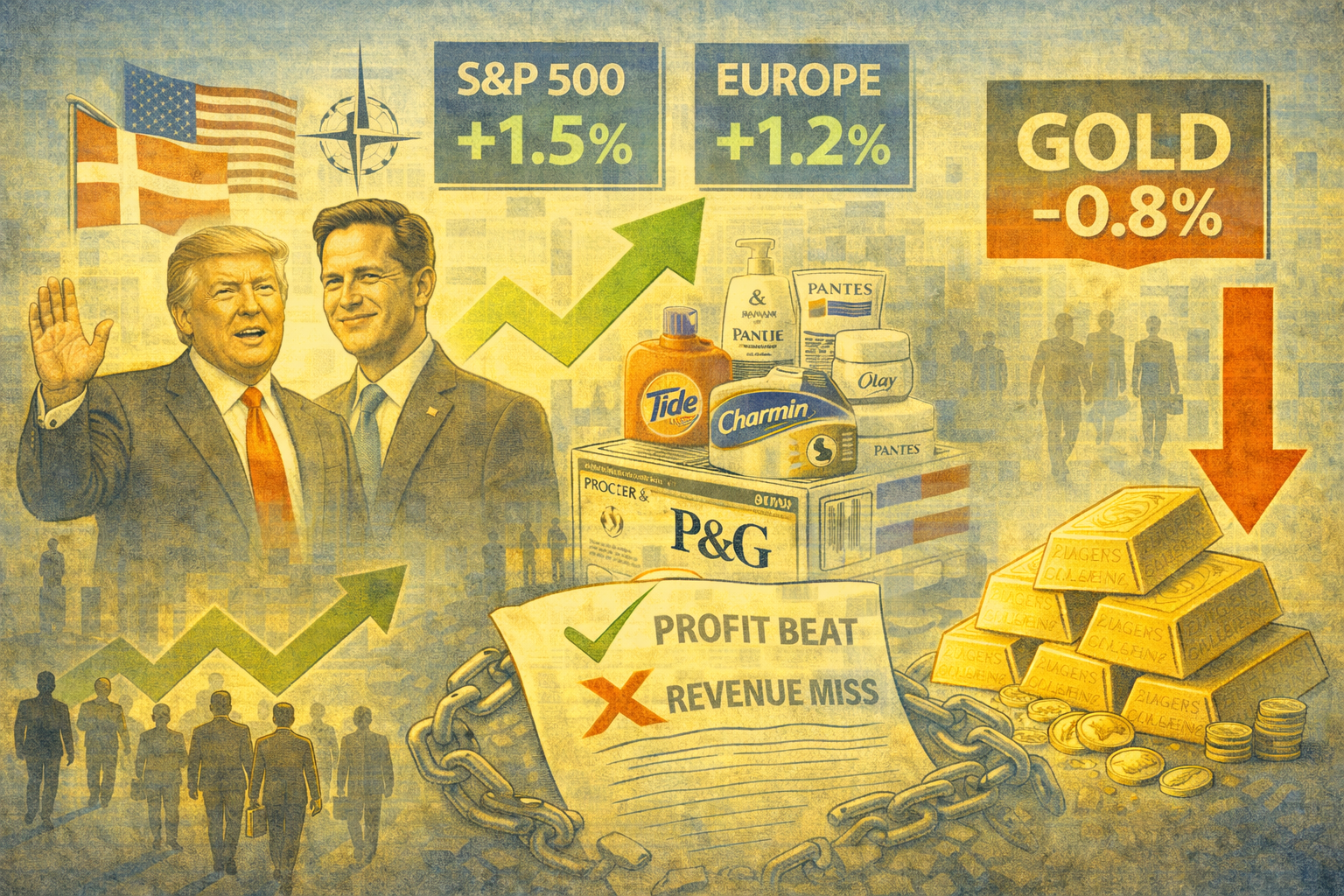
Global markets steadied on Thursday after President Donald Trump abruptly walked back his tariff threat linked to Greenland at Davos, sparking a relief rally in US and European equities, even as the details remain unclear.
In corporate news, Procter & Gamble beat profit expectations but missed revenue targets, pointing to softer consumer demand and new tariff pressure.
Commodities cooled too, with gold retreating from record highs as risk appetite returned.
Meanwhile, US spending held up, though widening inequality and a falling savings rate highlight underlying strain.
Trump’s U-turn on Greenland lifts sentiment
US President Trump abruptly dropped his tariff threat on Wednesday at Davos after meeting NATO Secretary General Mark Rutte, claiming a “framework” agreement on Greenland’s future.
Markets surged on relief, the S&P 500 jumped 1.5%, while European equities recovered lost ground.
Yet ambiguity persists: the specifics remain deliberately vague, with Trump vowing “total access” but declining to clarify ownership versus military basing rights.
Denmark maintains an ironclad stance; sovereignty is non-negotiable, period.
The framework hinges on renegotiating a 1951 defense pact and preventing Chinese/Russian Arctic encroachment, but Trump’s demand for permanent US control fundamentally clashes with Danish law.
European analysts remain cautious: Germany’s Klingbeil warned against “letting hopes rise too quickly,” while both Greenlandic residents and lawmakers expressed skepticism.
P&G beats profit but misses revenue
Procter & Gamble reported a mixed quarter Thursday, posting core earnings of $1.88 per share, beating estimates of $1.86, but falling short on revenue at $22.21 billion versus $22.28 billion expected.
The miss signals a consumer retrenchment beyond Wall Street’s radar: organic sales flat-lined as volumes sank 1%, offset only by 1% price hikes.
Laundry detergent and toilet paper sales weakened in the US, while cash-strapped households reduced spending on essentials, and a government shutdown delaying food assistance payments worsened the pain.
Beauty outperformed with 3% volume growth (Pantene, Olay), the sole bright spot representing 18% of sales.
P&G’s core gross margin fell for the fifth straight quarter, squeezed by Trump tariffs and packaging costs.
New CEO Shailesh Jejurikar expects H2 recovery but slashed full-year EPS guidance to 1-6% growth from 3-9%, citing $400 million in tariff headwinds.
Gold corrects from record highs
Gold retreated 0.8% to $4,796.75 per ounce on Thursday, pulling back from Wednesday’s record $4,887.82 peak after Trump abandoned tariff threats over Greenland, erasing a key risk-off catalyst.
The three-day rally that pushed bullion to all-time highs unwound as investors banked profits and appetite for safe-haven assets evaporated alongside geopolitical tensions.
A firmer dollar compounded pressure, gold priced in greenbacks becomes pricier for foreign buyers when the USD strengthens.
Platinum slid nearly 2% to $2,433 while silver dipped 0.1% to $93.19, both retreating from record highs.
Yet Goldman Sachs raised its December 2026 gold forecast to $5,400 from $4,900, citing persistent private investor diversification and central bank demand (projected 60 tons in 2026).
ANZ’s Kumari notes underlying support remains from geopolitical persistence and central bank backing despite near-term correction.
US consumer spending holds strong
US consumer spending rose 0.5% in both October and November, hitting the median economist forecast and fueling expectations for third-quarter GDP growth around 4.4%, with the Atlanta Fed projecting Q4 at 5.4%.
The resilience masks deepening inequality: higher-income households drove 2.4% YoY spending growth versus 0.4% for lower-income earners, a classic K-shaped recovery.
Notably, nearly half of November’s gains came from healthcare and energy spending, suggesting inelastic rather than discretionary demand.
Real spending (inflation-adjusted) gained only 0.3%, while personal savings collapsed to 3.5%, the lowest since October 2022, as income growth stalled at 0.3% after taxes.
PCE inflation held at 2.8% annually; core PCE was also flat at 2.8%. Tariffs inflated prices on goods while demand weakened for big-ticket items like electronics and appliances.
Bank of America data confirms lower-income households traded down 75% of categories, favoring small-ticket deals over luxury goods.
The post Evening digest: P&G misses revenue, gold slips, US spending stays resilient appeared first on Invezz
