
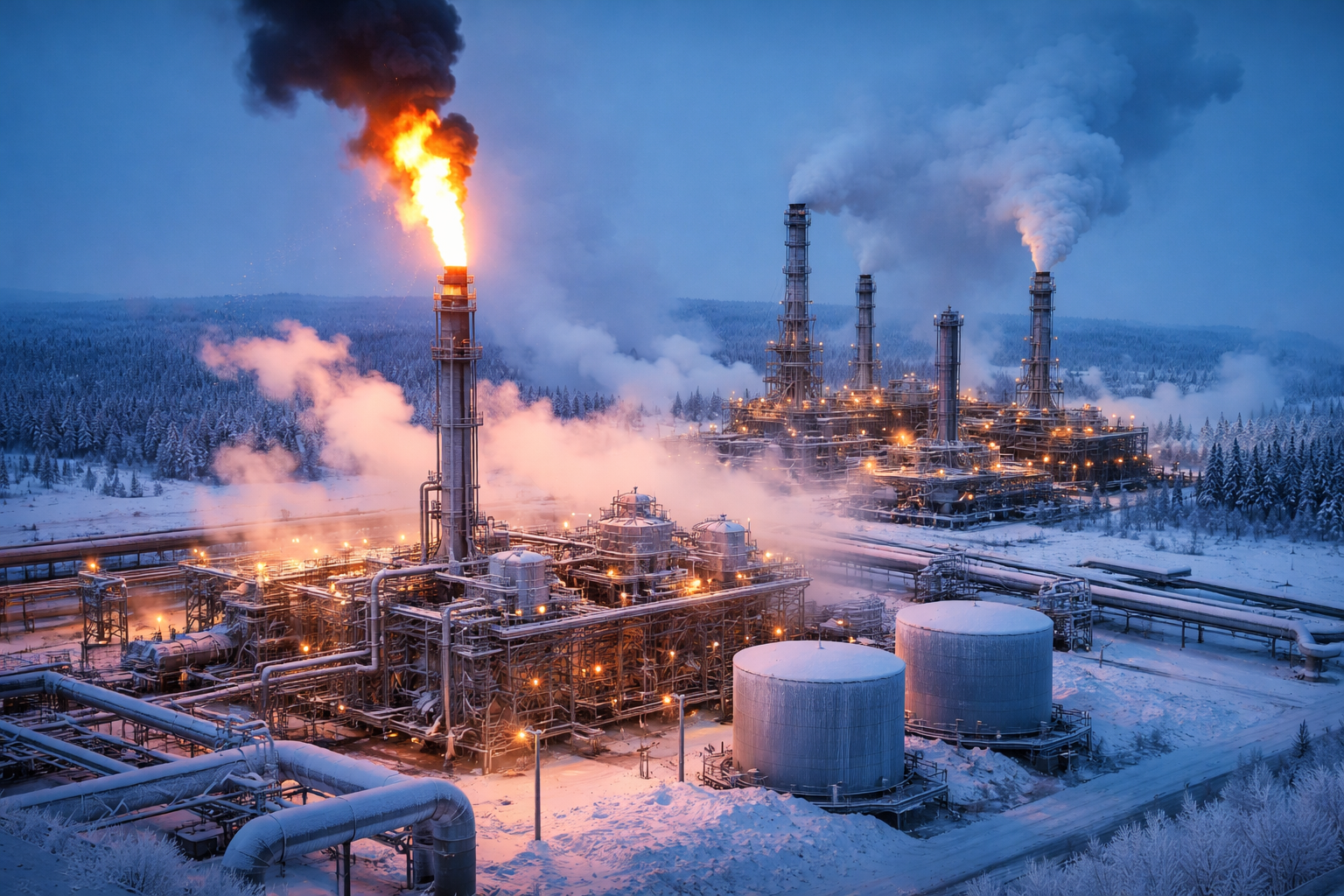
Natural gas was close to ending 2025 flat, or even slightly down. Throughout the year, prices drifted, storage looked fine, and winter forecasts stayed mild enough to keep traders relaxed.
November was the first price spike that started changing the outlook. Then, as soon as the year changed, the market started moving faster than anyone expected.
In less than a week, US gas prices went from boring to violent, breaking levels not seen since 2022.
But this is not just a story about the weather. The gas market now looks fragile, and investors are focusing on positioning over fundamentals.
So, what should investors expect for the rest of the year? Will US gas prices keep surging?
How prices ran out of control so quickly
The raw numbers explain why traders were caught off guard. US natural gas futures surged around 70% in a single week, followed by another sharp move that pushed the front month above $6 per million British thermal units (Btu) for the first time since late 2022.
Spot prices reacted even more aggressively. Cash prices at the Henry Hub briefly jumped into double digits, while some regional hubs printed levels that would normally only appear during emergencies.
Source: Bloomberg
At first glance, cold weather explains most of it. A deep Arctic blast covered large parts of the US, sending heating demand sharply higher.
Power plants pulled more gas as electricity usage climbed toward winter records.
At the same time, freezing temperatures disrupted production. Estimates suggested close to 10% of US gas output was temporarily knocked offline as wells and pipelines struggled with freeze-offs.
Weather models kept turning colder day after day, forcing traders to adjust positions in real time.
There was no gradual repricing. It happened in bursts.
European natural gas rose in parallel. In fact, EU gas prices rose by more than 50% to €42.4 per megawatt-hour, the highest in almost a year.
When positioning becomes the story
The real accelerant was how the market was positioned going into January. After months of mild weather and comfortable inventories, many traders were betting on lower prices.
Hedge funds, algorithmic strategies, and short term traders were leaning the same way.
When forecasts flipped, those positions became a problem. Short covering started early in the rally and intensified as prices broke technical levels.
Algorithmic traders were forced to buy back contracts as losses grew.
Liquidity in the front month was thin because the February contract was close to expiry, which made every order move the price more than usual.
That combination turned a fundamental weather rally into a squeeze.
The market was not discovering a new long term value for gas. It was reacting to positioning that no longer made sense.
This is why deferred contracts behaved differently. March futures rose, but far less dramatically.
The curve steepened, showing stress concentrated in immediate delivery rather than across the year.
Storage looked fine until it didn’t
One reason the rally felt so abrupt is that storage did not look tight before the storm.
US inventories were still above the five-year average, and early winter withdrawals had been modest.
That gave traders confidence that the system could handle colder weather.
The problem was speed. Once the freeze hit, withdrawals accelerated.
Weekly draws exceeded expectations, and forecasts pointed to even larger pulls as the cold persisted. Storage was no longer the buffer it appeared to be at the start of winter.
There is also a structural angle. While LNG export capacity has expanded rapidly, gas storage has not grown at the same pace.
More gas is moving through the system, but the cushion has not kept up. That leaves less room for error when demand and supply collide.
Why the US can no longer have a local gas crisis
A decade ago, a US cold snap mostly stayed in the US, but that no longer applies.
That’s because around 17-18% of American gas production now feeds LNG export terminals. When domestic prices spike or production drops, global flows react.
During this episode, gas flows to LNG plants fell to the lowest level in about a year as freeze offs disrupted supply.
That immediately tightened the global LNG market.
Europe saw big price jumps, as the region is still reliant on US cargoes after losing most Russian pipeline gas.
In Asia, prices rose too, although large buyers like China and Japan were better protected by inventories and long-term contracts.
Smaller importers felt the pain. Some cancelled tenders outright as prices moved beyond what utilities could absorb.
Cargoes that might have gone to Asia were suddenly more likely to sail to Europe, not because of politics but because of price signals.
Natural gas has become a global commodity in practice, not just in theory. Weather in Texas can now influence power prices in Europe within days.
Power grids, politics, and physical limits
The freeze exposed another layer of risk. Gas is now the backbone of US power generation, having displaced coal over the past decade.
When temperatures plunge, gas demand rises from both homes and power plants at the same time.
Grid operators responded by urging utilities to secure fuel supplies through the cold spell.
Transport networks strained. Thousands of flights were grounded. The system held, but just barely in some regions.
High prices help producers on paper, although even they face risk if gas cannot be delivered physically.
For consumers, the impact is immediate. Heating bills rise quickly during cold snaps, and political pressure follows.
Energy inflation has a way of showing up when it is least welcome.
What the 2026 price outlook really tells us
Forecasts for natural gas in 2026 look calm compared with recent spot prices.
February futures above $6 reflect immediate stress from cold weather, supply disruptions, and thin liquidity, not a new long-term baseline for natural gas.
Looking beyond the next few months, most major forecasts point much lower. Banks, consultants, and government agencies mostly see average prices in the mid-three-dollar range this year, rising gradually into 2027.
Enverus sees winter prices near $3.8 and summer closer to $3.6, with a gradual rise later in the decade.
The US Energy Information Administration is more conservative, forecasting a 2026 average near $3.5, rising toward the mid-$4 range in 2027.
Those numbers are not wrong. They reflect expectations that winter extremes fade, production recovers, and LNG supply growth continues later in the decade.
But averages hide the real story. The market is no longer smooth. Volatility is the feature, not the flaw.
Short term pricing is now more sensitive to weather, infrastructure stress, and financial positioning than it was even five years ago.
The lesson from this winter is not that gas has entered a new permanent bull market. It is that the path between calm and chaos has become much shorter.
When production, storage, exports, and power demand all lean in the same direction, prices have nowhere to go but up.
The post Is cold weather really all it takes for natural gas to rally? Price outlook for 2026 appeared first on Invezz
